Three garments, roughly the same price, made from roughly the same cotton, doing what looks like roughly the same job. And yet the hoodie, the crew-neck sweatshirt and the half-zip behave completely differently once they are in your wardrobe — in how warm they keep you, how formal they read, and how many other things they will go with.
Most men buy the wrong one, because they buy the one they see most rather than the one that matches how they actually spend their days. This guide settles the comparison properly, across warmth, versatility and fit, so you can choose once and choose correctly.
The short answer
If you only want one and you dress casually, buy the hoodie. If you want one that works in an office or over a collar, buy the half-zip. If you want the most versatile layering piece that disappears under a jacket, buy the crew-neck.
The reasoning matters more than the verdict, so here it is in full.
Warmth: how they actually compare
The hoodie leads, because of the hood
A hood is not decoration. It traps a layer of warm air around the neck and head, and a substantial share of body heat is lost from exactly there. Add the double-layer fabric across the shoulders and upper back where a hood sits when down, and the hoodie is meaningfully warmer than its two rivals in the same weight of cotton.
It also handles wind and light rain in a way the others simply cannot. For genuinely cold or exposed conditions, this is the one.
The half-zip is adjustable, which is often better
Raw warmth is not the whole story. A half-zip lets you regulate temperature through the day — zipped to the throat outdoors, opened indoors. In a climate where the difference between a cold street and a heated room is twenty degrees, adjustability beats insulation. This is why the SIGMAN Half Zipper Long Sleeve tends to get worn more days per season than anything else in the range.
The crew-neck is the base layer
Least warm on its own, but the best under something else. No hood to bunch up under a coat collar, no zip hardware to catch. A crew-neck like the Crew Neck Triko is what you wear when the outer layer is doing the real work.
Versatility: which one goes with the most
Warmth is easy to compare. Versatility is where the real decision lives.
Hoodie: casual only, but excellent at it
A hoodie is unambiguously casual. That is a feature, not a flaw — it is the most comfortable and most confident piece in a relaxed wardrobe, and no amount of styling makes it appropriate for a formal setting. Do not fight this. Wear it where it belongs and it is unbeatable.
Half-zip: the crossover piece
The half-zip is the only one of the three that moves between registers. Zipped up it reads as a mock-neck, which is close to smart-casual. Open over a t-shirt it is entirely relaxed. Over a collared shirt it becomes genuinely office-appropriate. One garment, three distinct impressions.
Crew-neck: quiet and dependable
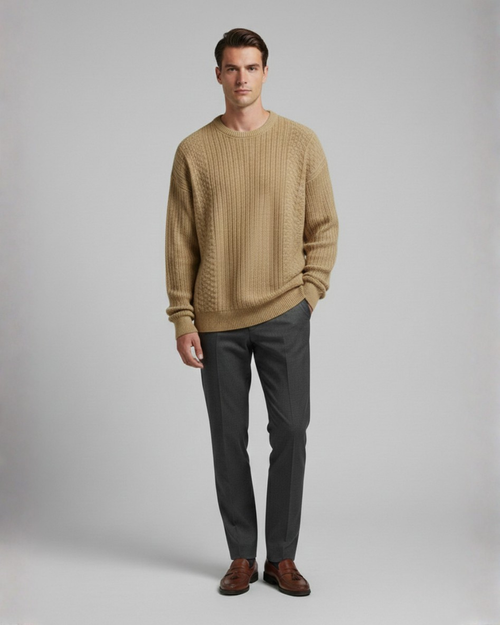
The crew-neck sits in the middle and never draws attention. In a fine knit it reads noticeably more refined than a hoodie — close to a lightweight sweater — which makes it the safest of the three when you are unsure of the setting.
Fit and fabric
Getting the fit right
All three of ours are cut with a relaxed oversized fit, which is the right shape for a layering piece — you need room for what goes underneath, and volume on top is what makes the modern silhouette work.
The check is the same across all three: the shoulder seam should sit two to three centimetres past your natural shoulder, not halfway down your bicep. Buy your normal size in a cut already designed as oversized. Sizing up on top of that is the most common mistake and it collapses the whole line.
Why the fabric weight matters more in winter
Our hoodies use premium Milton cotton — a heavier, structured weave with a soft brushed interior that traps warm air. The half-zip and crew-neck use lighter weaves, because they are designed to layer rather than to stand alone.
Cotton earns its place in winter for the same reason it does in summer: it breathes. Synthetic fleece is warmer per gram but traps moisture, which is why you overheat indoors and then feel cold the moment you step out. Cotton regulates. Our guide to fabrics covers the mechanism in detail.
Building a three-layer winter system
If you are buying properly rather than buying one thing, the system that works is straightforward.
Base: a cotton t-shirt or fine crew-neck against the skin, to move moisture away.
Mid: the hoodie, sweatshirt or half-zip — this is your adjustable insulation and the layer you add or remove as the day changes.
Outer: a jacket or overcoat for wind and rain, worn only when you are actually outside.
The reason layering beats one thick garment is control. Three moderate layers trap more air than one heavy one, and you can remove them independently. The Winter Collection is built to work as a system rather than as isolated pieces.
Recommended by SIGMAN
Where to start, depending on what you are missing:
- Basic SIGMAN Hoodie — premium Milton cotton, soft brushed interior. The foundational casual layer, in colours that go with everything.
- Half Zipper Long Sleeve — the most versatile of the three. Buy this if you can only buy one and your days vary.
- Crew Neck Triko — fine-knit cotton, refined enough to wear alone, clean enough to layer under anything.
- Heart Hoodie — for when the layer should have some character rather than just do a job.
Browse the full Winter Collection, or see how the same cuts translate in lighter weights in the Summer Collection. A warm, woody fragrance from the Fragrance Collection finishes a cold-weather look properly — cold air suppresses projection, so heavier compositions come into their own.
Final word
The question is not which of these is best. It is which one matches the life you actually live. If your days are casual, the hoodie will get worn four times a week and everything else will sit in the drawer. If your days move between settings, the half-zip will quietly become the most-worn thing you own. Buy for the days you have, not the days you imagine.
For the wider cold-weather picture, read our winter men's fashion essentials guide.
Frequently asked questions
Is a hoodie warmer than a sweatshirt?
Yes. In the same fabric and weight, a hoodie is measurably warmer because the hood traps heat around the neck and head, and the fabric doubles over the shoulders where the hood rests. It also offers some protection from wind and light rain.
Can you wear a half-zip to the office?
In most modern workplaces, yes — particularly zipped up as a mock-neck or worn over a collared shirt. It is the only one of these three layers that reads as smart-casual, which is exactly why it is the most versatile of the three.
What should I wear under a hoodie in winter?
A cotton t-shirt or a fine crew-neck. The base layer's job is to move moisture away from your skin, so it should be breathable and reasonably close-fitting. Avoid synthetics directly against the skin — they trap sweat and leave you cold once you stop moving.
Should I size up in an oversized hoodie?
No. An oversized cut already has the extra volume built into the pattern. Buy your normal size and check the shoulder seam sits about two to three centimetres past your natural shoulder. Sizing up drops the seam down your arm and ruins the silhouette.
Is cotton warm enough for winter?
For most winter conditions, yes — particularly a heavier structured cotton with a brushed interior, worn as part of a layered system. Cotton's advantage over synthetic fleece is that it breathes, so you do not overheat indoors and then chill when you step outside.
How many winter layers do I actually need?
Three well-chosen pieces cover almost everything: one hoodie, one half-zip and one crew-neck. Combined with t-shirts underneath and a jacket over the top, that handles the full range from a mild afternoon to a genuinely cold night.